
‘Green Fee’ project spending faces shakeup
By Andrew Gomes for Honolulu Star-Advertiser
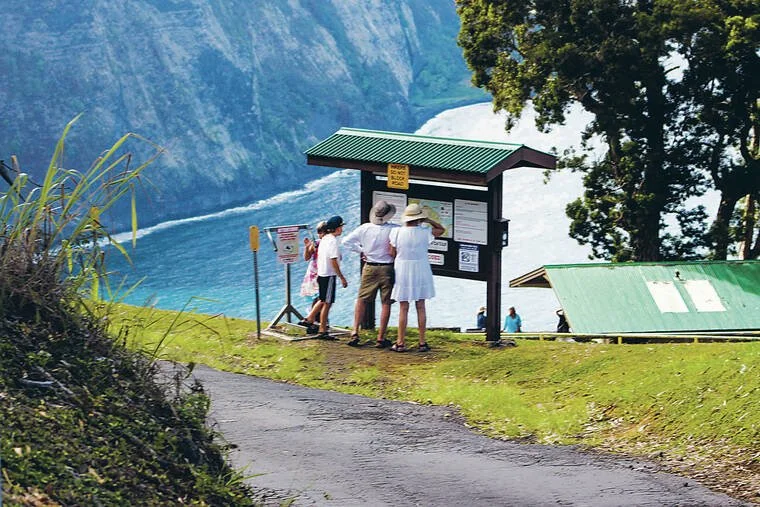
Megan Moseley / Special to Star-Advertiser
How the state spends nearly $130 million on initial projects to protect natural resources, mitigate disaster risk and improve visitor experiences under Hawaii’s new “Green Fee” program is facing reshuffling at the Legislature.
Some powerful senators don’t want to fund about $65 million of projects recommended by an advisory council in January and instead have proffered their own list of suggested replacements.
Replacement recommendations include $12 million for a food and product innovation network, $800,000 for the state Department of Education to comply with the federal Americans with Disabilities Act, and $350,000 for a sports and signature events study.
Potential eliminations include $10.6 million to support community-driven reforestation and natural habitat improvement work, $5 million for homeowners to reduce high-wind damage risks and $1 million to cease cesspool use in the nearshore Honaunau community on Hawaii island.
The desired shakeup was put forth by the 13-member Senate Ways and Means Committee within a recently published 706-page list of proposed appropriations for the state budget bill.
WAM amended the budget measure, House Bill 1800, April 8 during a public hearing at which there was no mention or discussion of the dramatic changes proposed for Green Fee project funding generated by an expanded visitor industry tax that went into effect Jan. 1.
On April 14, the full 25-member Senate unanimously passed WAM’s draft of the budget bill, which is now set up for a final compromise draft to be determined by a panel of Senate and House negotiators.
The House had amended the budget bill before the Senate and made no changes to Green Fee projects except for accounting expenses.
Sen. Donovan Dela Cruz, WAM chair, said a lot of the projects recommended by the 10-member Green Fee Advisory Council aren’t set up to timely spend funds, and thus would leave unused appropriations while other more-ready qualified projects sought by state agencies go unfunded.
“The whole thing is, don’t hold onto money that the state is just going to accumulate,” he said. “It’s either we’re going to spend it or we shouldn’t charge the tax. … This is tax dollars. You have to be practical.”
Dela Cruz (D, Mililani-Wahiawa-Whitmore Village) also said some advisory council-recommended projects through which community organizations would receive Green Fee funding passed through state agencies are more appropriately funded by state grants under a competitive annual awards process governed by the Legislature.
Projects not favored by WAM weren’t based on judgments of merit, he added.
The list of new projects offered by WAM was based on input from committee members who reviewed funding requests by state agencies, according to Dela Cruz. He said WAM followed up with the agencies to see if they could spend funding relatively soon.
“We worked hard to make sure that we knew that the departments can actually spend the funds,” he said.
Jeff Mikulina, chair of the advisory council and executive director of Climate Hawai‘i who also previously led the Blue Planet Foundation, said readiness of projects was one of the council’s priority considerations, and that the legislation enacted in 2025 as Act 96 to establish the Green Fee program was designed to include community projects.
Mikulina also fears that discounting so much of the council’s list, which he described as a product of deep analysis and public outreach by a group possessing decades of subject-matter experience, could undermine public support for the program before it gets off the ground.
“This was a pretty rigorous, robust process,” he said of the work by the council, whose other members include the state director of The Trust for Public Land, Lea Hong, University of Hawai‘i Sea Grant College Program faculty member Dennis Hwang, and Hawai‘i Community Foundation COO Michelle Ka‘uhane.
“It was surprising,” Mikulina said, “that the Senate chose to essentially take out half of the recommendations, and then insert some proposals that don’t seem to really align with the intent of Act 96 as they passed it last year.”
Descriptions of Green Fee projects added to the budget bill by WAM are limited to only a few words each in the “budget worksheet” list for HB 1800. So it’s hard to assess the nexus between some projects and broad requirements under Act 96.
Act 96 project requirements include protecting natural resources, improving the resilience of structures against environmental conditions that include sea-level rise and disasters, improving the visitor experience, and mitigating impacts of tourism on the natural environment.
One concentration of projects recommended by WAM would improve state boating infrastructure, including $3 million to repair a boat ramp and improve floating docks at Puako on Hawaii island, and four projects to improve harbor or wharf facilities in Kailua-Kona and Honokohau on Hawaii island and in Maalaea and Kihei on Maui for a combined $1.3 million.
Funding for roughly 50 or so new recommended projects also includes $250,000 for solid waste management, $300,000 for international relations, $500,000 for fire ant containment, $650,000 for a Kure Atoll ecological restoration field station, $700,000 for the Waikiki Aquarium, $1.1 million for a green energy study, $2 million for the Hawaii Invasive Species Council, $3 million for highway debris removal, $3.7 million for a UH biosecurity facility and $5 million for urban extreme heat reduction.
Funding for advisory council projects not desired by WAM includes $150,000 to produce more striped mullet in fishponds, $250,000 to create more native plant nurseries, $1.6 million to protect native birds from threats including mosquito-born avian malaria, $5 million to reduce the spread of invasive plant and animal species, $6 million for Hawai‘i Wildfire Risk Reduction and Firewise Communities programs, and $7.6 million to expand community-based visitor education and stewardship.
The advisory council, formed by Gov. Josh Green in August, received over 500 project requests exceeding $2 billion in funding from government agencies, community groups and nonprofit organizations.
Tax revenue for the Green Fee program is being generated by a higher and expanded state Transient Accommodations Tax. The state Department of Taxation projects the additional revenue will amount to $87 million annually. The council proposed an initial tranche of funding comprised of $42.2 million for the second half of the current fiscal year running from Jan. 1 to June 30, and $84.3 million next fiscal year.
Under Act 96, money for Green Fee projects is to be pulled from the state’s general fund based on approximated Green Fee revenue. WAM seeks to have Green Fee tax revenue put into a special fund that allows program spending to be more easily tracked.
Mikulina acknowledges that Act 96 gives the Legislature the final call on Green Fee program spending after receiving recommendations from the governor.
“This is a legislative process, and we get it,” he said. “There’s give and take, and there’s imperfect information. And I think everyone’s doing their best and thinks how can we put these dollars to work to really invest in what we need to, to improve climate resilience, regenerative tourism and environmental stewardship. There’s still an opportunity to restore some of these investments, and we hope the Legislature recognizes that.”
A House and Senate conference committee held its first meeting to hash out differences on numerous appropriations in the more than $10 billion budget bill on Wednesday.
On Friday, the meeting resumed and is expected to be followed by several more that typically resolve differences in batches before agreeing on a full final budget bill draft subject to passage by the House and Senate before the end of this year’s legislative session scheduled for May 8.
No public testimony is allowed during conference committee meetings. Mikulina is hopeful that the council’s work holds up in the final draft, and that the Green Fee program is regarded as having a successful start.
“This is the first year, and it’s truly precedent-setting — not just for Hawaii, but for others that are watching,” he said. “We really want to get this right, and show that a visitor impact fee can be put to work to really improve the visitor experience while we’re protecting Hawaii for future generations, and making a dent in that backlog of deferred maintenance for our ecosystem that’s been underfunded for so long.”
Click here to read the full article published by Honolulu Star-Advertiser on Apr. 28.
